at the beginning of the story
The Merchant’s Abduction
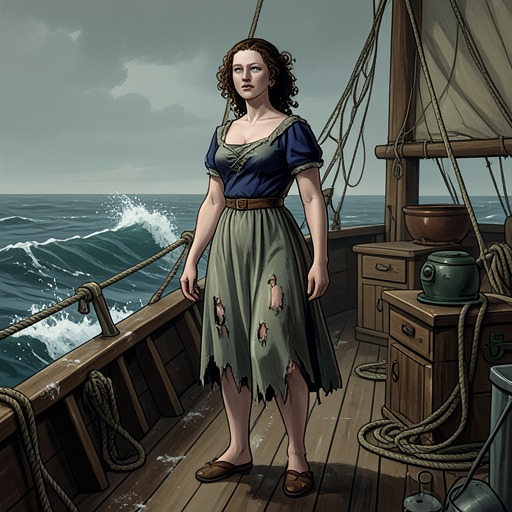
A merchant traveling in a foreign country fell in love with a young lady whose birth and wealth far surpassed his own. Seeing little hope of winning her openly, he seized an opportunity while she gathered shells on the shore and carried her off in a small, provisioned vessel.
His attempt to make himself happy instead set the story in motion as a crime against the lady and a provocation to the powers governing the world. The boat was soon caught in a violent storm and swept northward.
immediately after the abduction
Across the Icy Passage
The storm drove the light vessel toward the [North Pole](entity:location-recall-location-north-pole-bbc0ed763b1f) and into the [Icy Sea](entity:location-recall-location-icy-sea-81d48a2afedc), where enormous floes threatened to crush it. The men, unprepared for the cold, froze to death; the young lady alone survived, protected by her youth, beauty, and the gods’ favor.
The boat was carried through the joined poles into another world. The story presents the passage as a boundary between worlds: the poles block a route around the familiar globe but permit passage into a neighboring one.
after the boat enters the new world
The Bear-Men’s Rescue
As the dead sailors began to thaw and decay, the young lady moved onto the deck to escape the stench. Bear-like people who walked upright came across the ice, inspected the vessel, carried her out, and sank the boat with the dead men still aboard.
Though their appearance frightened her, the [Bear-men](entity:character-recall-character-bear-men-31d9cc4d5fe3) treated her with kindness. They carried her across the slippery ice to their underground city and entrusted her to the care of their women, beginning her passage through an unfamiliar society rather than an ordeal of captivity.
soon after her rescue
The Journey to Paradise
The [Bear-men](entity:character-recall-character-bear-men-31d9cc4d5fe3) recognized that the cold climate and their food did not suit their guest, so they took her to a warmer island inhabited by upright [Fox-men](entity:creature-recall-creature-fox-men-748c16aa6c38). The Fox-men and their neighbors escorted her onward through lands of [Bird-men](entity:character-recall-character-bird-men-f10444efd7ce), [Satyrs](entity:creature-recall-creature-satyrs-492996853657), and green-complexioned people, crossing rivers in boats and barges.
As she learned enough of the languages to understand her attendants, fear gave way to confidence. The many peoples cooperated in sending her to their Emperor, whose residence lay beyond a difficult sea passage; their unusual ships and navigation carried her safely toward the imperial center.
at the end of her journey across the Blazing-World
Arrival at Paradise
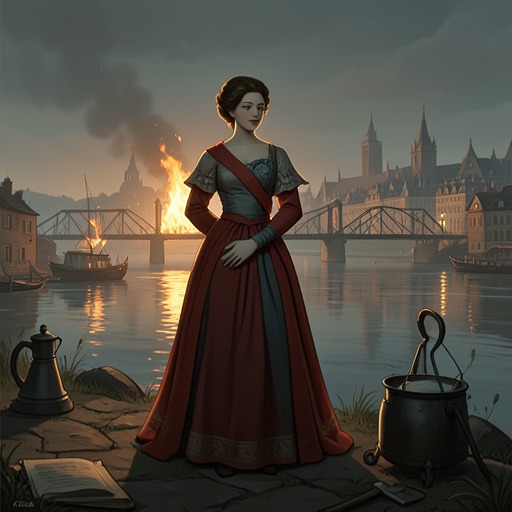
The lady reached the Emperor’s domain through a narrow, winding passage among towering rocks, navigable only by small boats. Beyond it lay a temperate region divided by rivers into rich islands and jeweled cities, culminating in [Paradise](entity:location-recall-location-paradise-663ff8e635ea), an imperial city built of gold and crisscrossed by waterways and bridges.
The Emperor’s palace displayed extraordinary architecture and precious stones, while a single ruler and a single language held the many peoples in peace. The setting establishes the wealth, political unity, and ceremonial splendor of the world into which the lady has arrived.
upon her presentation to the Emperor
The Lady Becomes Empress
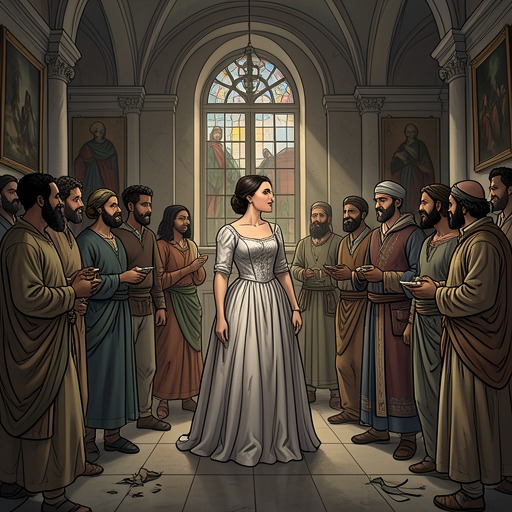
The Emperor took the beautiful stranger for a goddess and offered to worship her. She corrected him, explaining that she was mortal despite having come from another world; delighted by the revelation, he married her and granted her absolute authority to govern.
Her subjects continued to venerate her almost as a deity. Invested with imperial jewels and symbols of defense and power, she became the [Empress of the Blazing-World](entity:character-recall-character-empress-of-the-blaz-0e0d2f909819), turning an accidental arrival into sovereign rule.
soon after her accession
The Imperial Order
The new [Empress](entity:character-recall-character-empress-e4c788f61ae7) learned that gold and jewels were abundant but tightly restricted: only the imperial family could wear gold, and jewels were reserved for the Emperor, Empress, and their eldest son. Trade relied on exchanging goods rather than coin, while priests and governors came from the imperial bloodline and were made eunuchs.
She also found a society composed of many humanlike species, each associated with particular crafts and disciplines. The Emperor’s subjects described a common religion and a common political allegiance, presenting uniformity as the foundation of their continuing peace.
during the Empress’s first inquiries into her realm
Questions of Church and State
The [Empress](entity:character-recall-character-empress-e4c788f61ae7) questioned statesmen about why the world had few laws and a monarchy. They answered that excessive laws encouraged divisions and that a political body, like a natural body, should have one head. They connected this single sovereign to their belief in one God.
Priests told her that their peoples shared one religion despite worshipping in separate congregations. Women were excluded from public religious assemblies and public office, while eunuchs served as priests and governors to prevent family interests from disturbing church and state. The Empress listened, even as the answers revealed the restrictive terms of their orderly system.
during her early inspection of the imperial city
The Empress Questions Architecture
The [Empress](entity:character-recall-character-empress-e4c788f61ae7) asked the architects why their houses were no more than two stories high, why their walls were thick, and why they used arches and pillars. They argued that low, thick buildings resisted heat, cold, wind, and decay, while arches and pillars made structures both magnificent and durable.
Her inspection showed that she would test received practices by asking their purposes rather than accepting their grandeur at face value. She was satisfied with these practical explanations and moved from buildings to the learned professions she had established.
after the Empress’s inspection of the palace
The Learned Societies
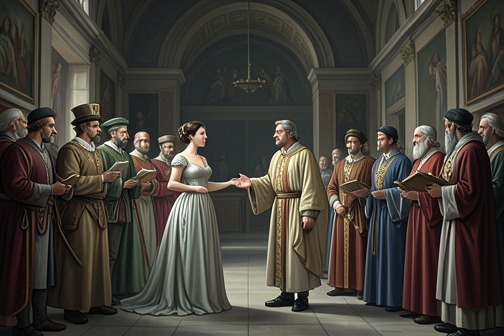
The [Empress](entity:character-recall-character-empress-e4c788f61ae7) summoned representatives of her newly organized scholars and assigned disciplines to different peoples. [Bear-men](entity:character-recall-character-bear-men-31d9cc4d5fe3) became experimental philosophers; [Bird-men](entity:character-recall-character-bird-men-f10444efd7ce) studied astronomy; [Fish-men](entity:character-recall-character-fish-men-50f3d184cbf2) and [Worm-men](entity:character-recall-character-worm-men-adeda3331596) investigated nature; [Ape-men](entity:character-recall-character-ape-men-8f276d2118ac) practiced chemistry; and other species took up medicine, politics, mathematics, rhetoric, architecture, and related arts.
Her project made learning an instrument of government, but it also exposed how observation and argument could produce competing accounts rather than settled truth. The Empress’s interviews would repeatedly test the confidence of specialists against the limits of their senses and methods.
during the Bird-men’s first report
Competing Accounts of the Heavens
The [Bird-men](entity:character-recall-character-bird-men-f10444efd7ce) described the Sun as a fixed, solid stone and the Moon as a shining body with its own light. They offered conflicting accounts of solar heat and light, disagreeing over fire, reflected light, and the motion of subtle matter; they also debated the spots on the heavenly bodies and the nature of wind and snow.
Their report gave the [Empress](entity:character-recall-character-empress-e4c788f61ae7) a picture of inquiry in motion, but not a decisive account of nature. The disputes prompted her to authorize optical instruments, a decision that soon intensified rather than resolved disagreement.
after the Bird-men’s first astronomical report
The Telescopes Multiply Disputes
The [Empress](entity:character-recall-character-empress-e4c788f61ae7) ordered the [Bear-men](entity:character-recall-character-bear-men-31d9cc4d5fe3) to use telescopes to examine celestial bodies. The instruments yielded incompatible interpretations: some observers said the Earth moved around a stationary Sun, others that both moved, and others that the Sun moved around a stationary Earth. They also disagreed about stars, the Moon, and whether three appearances near the joined pole were one star or several.
The Empress concluded that the telescopes were false informers and ordered them broken, arguing that natural sense and reason were more reliable than artificial glass. The Bear-men protested that the instruments did not cause their disagreements; the irregularity lay in observers’ perceptions and judgments, and disputes themselves gave their work pleasure.
immediately after the order to break them
The Empress Spares the Telescopes
The [Bear-men](entity:character-recall-character-bear-men-31d9cc4d5fe3) pleaded that their telescopes were dear to them because they supplied subjects for argument and opportunities to refute one another. They valued artificial delusions, they said, more than natural truths, and feared a world without disagreements would leave their senses and intellects without employment.
The [Empress](entity:character-recall-character-empress-e4c788f61ae7) relented on condition that scholarly disputes remain within the schools and do not disturb the state. The episode established a boundary between intellectual controversy and political order: she tolerated divided opinions as long as they did not become factions.
after the Empress permits the telescopes to remain
The Microscope Demonstrations
The [Bear-men](entity:character-recall-character-bear-men-31d9cc4d5fe3) showed the [Empress](entity:character-recall-character-empress-e4c788f61ae7) a fly’s compound eyes, pores in charcoal, and supposed poison-filled structures beneath nettle points, presenting magnified appearances as discoveries. She questioned whether the visible structures proved the claims attached to them, while the experimenters insisted their microscopes corrected the senses.
A flea and a louse magnified into frightening creatures, prompting the Empress to pity the poor who fed them with their own blood. When she asked whether the instruments could prevent bites, the Bear-men treated the practical question as beneath their discipline. Their demonstrations exposed the distance between producing observations and using them to relieve human suffering.
during the Bear-men’s microscope demonstrations
The Limits of Optical Glass
The [Bear-men](entity:character-recall-character-bear-men-31d9cc4d5fe3) could magnify tiny creatures but could not fit the whole shape of a whale into their instrument’s field. At the [Empress](entity:character-recall-character-empress-e4c788f61ae7)’s request they devised glasses that contracted objects instead, making whales seem like small fish and elephants like fleas.
Yet even their expanding and diminishing devices could not reveal a vacuum, immaterial substances, or beings between something and nothing. Their failure confirmed a recurring problem in the Empress’s inquiries: instruments can change what appears to the senses without granting access to every kind of reality.
during the Empress’s natural-philosophy hearings
The Fish-Men’s Account of the Sea
The [Fish-men](entity:character-recall-character-fish-men-50f3d184cbf2) attributed the sea’s saltiness and tides to volatile salt in the earth that the waters absorbed, describing the ebb and flow as a motion caused by that exchange. They also reported that aquatic animals differed in their blood and bodily structures, while admitting that their observations could not settle how blood circulated inside living creatures.
The [Empress](entity:character-recall-character-empress-e4c788f61ae7) tested their explanations with further questions about animal life and respiration. Their answers stressed that nature’s kinds were various and that a single account of bodies could not be imposed on every creature.
during the same series of natural-philosophy hearings
The Worm-Men on Nature’s Variety
The [Worm-men](entity:character-recall-character-worm-men-adeda3331596) discussed bloodless insects, creatures that lived in both water and on land, and organisms produced from materials unlike themselves. The [Empress](entity:character-recall-character-empress-e4c788f61ae7) challenged their accounts with examples such as cheese and maggots; they replied that once a thing’s motions and form changed, it was no longer properly the same thing.
They also described natural bodies as having colors inseparable from matter, rejecting the idea that color was a detached, immaterial accident. The Empress found this account persuasive, accepting that bodily properties and forms could not be cleanly separated from the material nature that sustained them.
during the Empress’s inquiry into earth and water
Disputes Over Ice and Springs
The [Fish-men](entity:character-recall-character-fish-men-50f3d184cbf2) and [Bird-men](entity:character-recall-character-bird-men-f10444efd7ce) explained ice and snow through saline vapors and fiery extracts, while the [Worm-men](entity:character-recall-character-worm-men-adeda3331596) offered related accounts of frost. When the [Empress](entity:character-recall-character-empress-e4c788f61ae7) asked what happened to the supposed particles as the ice melted, none could answer. Their explanations of springs and tides likewise competed, ranging from underground caverns to salt and heat within the Earth.
The Empress noticed that some claims supported the Bird-men’s opinion that the Earth moved and the Sun remained fixed, but she continued to treat such reports as provisional. The hearings made disagreement an enduring feature of natural philosophy rather than a temporary obstacle on the way to certainty.
after the hearings with the Fish-men and Worm-men
The Empress Rebukes the Chymists
The [Ape-men](entity:character-recall-character-ape-men-8f276d2118ac) presented rival theories of the primary ingredients of natural bodies: the four elements, salt, sulphur and mercury, or water alone. Their competing experiments had not established a shared foundation, and their lengthy debate exhausted the [Empress](entity:character-recall-character-empress-e4c788f61ae7).
She argued that nature was one infinite, self-moving body, continually dividing, joining, and transforming its parts. Fire and the proposed chemical principles were themselves particular effects of nature, not the universal source of all bodies; she ordered the Chymists to stop wasting their labor on a search for primary ingredients and pursue useful experiments instead.
during the Ape-men’s report on chemical preparations
The Rejuvenating Gum
The [Ape-men](entity:character-recall-character-ape-men-8f276d2118ac) described a gum from a hollow rock near the golden sands that could restore a decayed old man to the appearance and strength of a twenty-year-old. Its slow treatment purged the body, removed hair, teeth, and nails, and eventually shed the skin like a single piece of armor before a long period of wrapping and restricted nourishment.
The account astonished the [Empress](entity:character-recall-character-empress-e4c788f61ae7), who had heard of famous medicines and alchemical marvels but not of a natural substance capable of renewing age. Because the gum grew naturally, she found it more credible than a result produced by art, which she regarded as nature’s inferior imitator.
after the Chymists’ hearing
Physicians and Monsters
Herbalists told the [Empress](entity:character-recall-character-empress-e4c788f61ae7) that herbs and drugs acted through their own natural motions, though their particular causes often remained unknown. When she asked the anatomists to dissect monsters, they refused, arguing that the work would not cure ordinary patients or prevent nature from producing further irregularities.
The Empress considered such examination useful to experimental philosophy, while the anatomists dismissed it as idle curiosity. Their disagreement again set practical medical purpose against investigation for its own sake.
after the physicians’ interviews
The Empress Rejects Formal Learning
The [Spider-men](entity:creature-recall-creature-spider-men-a92a3a35de39) presented mathematical points and figures that the [Empress](entity:character-recall-character-empress-e4c788f61ae7) found nearly imaginary, while the [Lice-men](entity:creature-recall-creature-lice-men-323a5de182fa) tried unsuccessfully to measure and weigh everything, including air. She dissolved the geometric society after their efforts failed to produce reliable agreement.
The [Parrot-men](entity:creature-recall-creature-parrot-men-4e0689a94b6e)’s elaborate speeches collapsed under their own divisions and rules, so the Empress urged them to attend to their subjects and rely on natural eloquence. When the Logicians demonstrated syllogisms that made politicians wise and beasts philosophers, she stopped them, arguing that art did not make reason; reason made art. She feared that formal logic obscured truth and disabled useful judgment.
after the Empress’s examination of the learned societies
The Women’s Congregation
Troubled that a learned people had little knowledge of divine truth, the [Empress](entity:character-recall-character-empress-e4c788f61ae7) decided to build churches and organize a congregation of women under her own leadership. She instructed them in her religion, and they soon became devout and zealous followers.
Her preaching won affection across the realm, but she worried that her subjects might later grow weary of belief and follow their own desires. She therefore sought a way to sustain religious commitment through persuasion and emotional experience rather than force.
after the women’s congregation is established
The Twin Chapels
The [Empress](entity:character-recall-character-empress-e4c788f61ae7) learned from the [Worm-men](entity:character-recall-character-worm-men-adeda3331596) of a stone that became intensely hot and burned when wet, then ceased when dry. [Bird-men](entity:character-recall-character-bird-men-f10444efd7ce) offered to obtain a piece of the Sun-stone, but proposed instead to break off one of the numerous stars; she used the materials to build two chapels in a dark cloister.
One chapel, lined with diamonds, held the fire-stone and could appear aflame when water was poured through artificial pipes. The other, lined with star-stone, cast a cool, comforting light. Moving in opposite circles, the chapels embodied punishments and consolation, giving her sermons of terror and hope a theatrical force.
after the chapels are completed
Persuasion and Religious Conversion
From the fiery chapel, the [Empress](entity:character-recall-character-empress-e4c788f61ae7) preached of punishment for sin; from the luminous chapel, she consoled those who repented. The fire-stone’s flame remained bearable, while the star-stone’s cool radiance made her appear angelic.
Through these staged symbols and her instruction, she converted the Blazing-World to her religion without compulsion or bloodshed. She held that fear could produce obedience but that love made it surer and more lasting, joining religious uniformity to a deliberate preference for persuasion over coercion.
after the Empress establishes her religion
The Spirits’ Visit
Wanting news of the world she had left, the [Empress](entity:character-recall-character-empress-e4c788f61ae7) asked whether immaterial spirits inhabited her new realm. The [Fly-men](entity:character-recall-character-fly-men-adb3f2ea68fd) said such beings occupied material vehicles, often made of air, and could communicate with her; they summoned spirits to answer her questions.
The spirits described themselves as dependent on bodies for motion and bodily speech, though they claimed a different, supernatural kind of knowledge. Their explanations repeatedly limited what they could know, challenging the assumption that spirits possessed a perfect account of divine or human mysteries.
during the Empress’s first conversations with the spirits
Debate Over Cabbala
The [Empress](entity:character-recall-character-empress-e4c788f61ae7) questioned the spirits about the [Cabbala](entity:concept-recall-concept-cabbala-438710ed1f7f), divine reason, numbers, creation, souls, and the afterlife. They denied that numbers held hidden mysteries, refused to claim a complete knowledge of God, and insisted that created spirits could not possess universal knowledge.
Their answers also described natural life and matter as inseparable, with spirits requiring corporeal vehicles for action. The Empress’s probing revealed both the reach and the limits of speculative theology: the spirits could dispute doctrines but could not settle the deepest questions of divine creation and human destiny.
at the end of the Cabbala discussion
The Spirits Disappear
When the [Empress](entity:character-recall-character-empress-e4c788f61ae7) said that she wished to make a Jewish [Cabbala](entity:concept-recall-concept-cabbala-438710ed1f7f), the spirits abruptly vanished. She fell into a trance and, after recovering, feared that their disappearance meant they had been punished or cast into a dark region because of some fault in their answers.
Her distress arose less from losing her informants than from believing she had caused their suffering. She sent the [Fly-men](entity:character-recall-character-fly-men-adb3f2ea68fd) and [Worm-men](entity:character-recall-character-worm-men-adeda3331596) to find them, turning a speculative conversation into a search across the material world.
soon after the spirits disappear
The Spirits Found at the Antipodes
The [Worm-men](entity:character-recall-character-worm-men-adeda3331596) searched beneath the Earth and learned that the spirits had passed through its center to the Antipodes. The [Fly-men](entity:character-recall-character-fly-men-adb3f2ea68fd) independently rounded the globe and confirmed that they had found them there, in good condition.
The spirits explained that their vehicles carried light like cats’ eyes, glow-worms, or rotten wood, so they did not fear the darkness that had troubled the [Empress](entity:character-recall-character-empress-e4c788f61ae7). They also offered to help with her proposed [Cabbala](entity:concept-recall-concept-cabbala-438710ed1f7f), easing her anxiety and showing that their departure had not been a punishment.
after the spirits return from the Antipodes
The Duchess Becomes Scribe
The spirits asked whether the [Empress](entity:character-recall-character-empress-e4c788f61ae7) wanted a scribe for the [Cabbala](entity:concept-recall-concept-cabbala-438710ed1f7f). They could dictate but needed a bodily hand to write; when she asked for the soul of a famous author, they proposed the [Duchess of Newcastle](entity:character-recall-character-duchess-of-newcastl-ccd8285fa60e) as a plain and rational writer.
The Empress welcomed the choice, noting that the [Duchess](entity:character-recall-character-duchess-9f1c6566987c) was of her own sex. The Duchess’s soul arrived and warned that her handwriting was difficult to read, but agreed to serve. The proposed mystical project immediately became a meeting between the Empress and the author who would narrate and shape much of the world’s history.
during the Duchess’s first audience with the Empress
The Duchess Rejects the Cabbala
The [Duchess](entity:character-recall-character-duchess-9f1c6566987c) advised the [Empress](entity:character-recall-character-empress-e4c788f61ae7) to seek a learned Jewish authority if she truly wanted a Jewish [Cabbala](entity:concept-recall-concept-cabbala-438710ed1f7f), warning that spirits and mortals alike were ignorant in many matters. She urged her to leave mystical scriptural interpretation alone and trust the plain sense of scripture rather than private invention.
When the Empress proposed philosophical, moral, and political Cabbalas instead, the Duchess argued that sense and reason were enough for nature, morality, and government. She suggested a poetic or romantic Cabbala as the one field where free interpretation might properly flourish. The Empress accepted the counsel and made the Duchess her favorite.
after the Duchess becomes the Empress’s favorite
The Duchess’s Ambition
The [Duchess](entity:character-recall-character-duchess-9f1c6566987c) confessed that her melancholy came from an ambition she could not measure and that she longed to become a great princess. The [Empress](entity:character-recall-character-empress-e4c788f61ae7) answered that her noble title already made her a princess of high rank, but the Duchess revealed that what she truly wanted was to rule a world as the Empress did.
The Empress promised to ask the spirits whether another world could be conquered. The Duchess’s desire for sovereignty exposed the tension between worldly fame and inward authorship that would shape the next stage of their friendship.
after the Duchess expresses her ambition
A World Within the Mind
The spirits told the two women that countless worlds existed but were already inhabited and governed. They discouraged conquest, arguing that rulers could enjoy only a small portion of a material world and that glory depended on other people’s opinions.
Instead, they proposed that each woman could create an immaterial world within her own mind, populated and governed according to her imagination. The [Duchess](entity:character-recall-character-duchess-9f1c6566987c) abandoned her wish to conquer an external realm and resolved to make a world of her own, turning ambition toward imaginative sovereignty.
while the Duchess begins creating her imaginary world
The Duchess Tries the Philosophers
The [Duchess](entity:character-recall-character-duchess-9f1c6566987c) first tried to build a world after Thales, but troublesome demons thwarted her. She then abandoned Pythagoras’s account when numbers overwhelmed her, and gave up Plato’s Ideas because their lack of independent motion made them difficult to manage.
An Epicurean world of atoms produced a blinding confusion, Aristotle’s principles seemed incompatible with her allegedly immaterial mind, and Descartes’s rapidly turning globules made her thoughts dizzy. Hobbes’s pressures and reactions left her mind painfully compressed. Each philosophical model proved difficult to inhabit as a world of her own.
after her failed attempts to imitate philosophical systems
The Duchess Creates Her Own World
The [Duchess](entity:character-recall-character-duchess-9f1c6566987c) finally abandoned borrowed patterns and made a world from rational, self-moving matter, the most subtle degree of matter in her account. Sensitive motions sustained the body, while rational motions formed the imagined world.
The world appeared varied, ordered, and wisely governed, giving her a pleasure that she could scarcely express in words. Her creation established the imagination not as a weaker copy of philosophical systems but as an independent power of world-making.
after the Duchess’s imaginary world is complete
The Empress Creates a Second World
The [Empress](entity:character-recall-character-empress-e4c788f61ae7), who had also been making and dissolving worlds in her mind, asked the [Duchess](entity:character-recall-character-duchess-9f1c6566987c) to show her the finished creation. She was so delighted by its order and variety that her own soul wished to live in it.
The Duchess encouraged the Empress to create a world of her own, offering her rational motions as a guide. The Empress followed this advice, designing inhabitants, laws, arts, and sciences for an imaginary realm alongside the Blazing-World she governed materially.
after both women have made imaginary worlds
The Empress Longs for Another World
The [Empress](entity:character-recall-character-empress-e4c788f61ae7) found the Blazing-World so well ordered that she could scarcely improve it, yet she wanted to see the [Duchess](entity:character-recall-character-duchess-9f1c6566987c)’s native world and examine its governments, laws, and customs. The Duchess warned that it was full of factions, divisions, and wars, but the Empress persisted.
To travel without alerting the Emperor, the Empress asked the spirits to place a substitute soul in her body. They promised an honest spirit who would resemble her closely, allowing her own soul to depart while her material body continued its ordinary life.
after the Empress arranges a substitute for her soul
The Journey to the Duchess’s World
The [Empress](entity:character-recall-character-empress-e4c788f61ae7)’s soul and the [Duchess](entity:character-recall-character-duchess-9f1c6566987c)’s soul traveled together into the Duchess’s native world, moving as lightly and quickly as thoughts. They observed its nations, governments, laws, religions, and assemblies, and the Empress was struck by how widely people shared ambition, pride, envy, malice, and a taste for war.
She wondered why kingdoms continually encroached on their neighbors and prized wealth and vanity above lives and tranquility. The Duchess answered that the Empress’s own rule showed how even a peaceful sovereign might find government more burdensome than pleasurable, and the two women concluded that moderation offered the greater happiness.
during the women’s tour of the Duchess’s world
The Empress Judges Monarchs
After observing rulers and courts, the [Empress](entity:character-recall-character-empress-e4c788f61ae7) called the Grand Signior the greatest monarch because his word functioned as law and his power seemed absolute. The [Duchess](entity:character-recall-character-duchess-9f1c6566987c) objected that religious law still constrained him, then promised to show the Empress a monarch whose smaller dominions were stronger and more justly governed.
The exchange showed the Empress comparing different forms of sovereignty rather than treating imperial power as self-evident. The Duchess directed her toward the royal court in her own country, setting up the Empress’s encounter with the Stuart royal family.
during the visit to the Duchess’s country
The Empress Visits the Theatre
The women entered a theatre where a play was being performed. The [Empress](entity:character-recall-character-empress-e4c788f61ae7) preferred the actors’ appearance, scenery, music, and dancing to the play itself, praising the immediate pleasures of performance over the supposedly witty or profitable relation.
The [Duchess](entity:character-recall-character-duchess-9f1c6566987c) explained that their poets disdained plain narration and built plays from old Greek and Roman stories or invented settings, adding new scenes and prologues to make them fresh. Their conversation established the Empress’s skepticism toward theatrical fashion and the Duchess’s awareness of the rules that governed it.
after their theatre visit
The Royal Court
At the royal court, the [Empress](entity:character-recall-character-empress-e4c788f61ae7) admired the balance of majesty and affability in the King and Queen, and she praised the Queen’s virtue and piety. She imagined that Mercury and Apollo had tutored the King, while the [Duchess](entity:character-recall-character-duchess-9f1c6566987c) credited her husband as his earthly governor.
The visit showed the Empress a model of royal dignity in the world she had come to inspect. The Duchess soon became melancholy, however, because she longed to speak with her husband, and the Empress agreed to accompany her to him in the country.
later on the same spiritual journey
Arrival at Welbeck
The two souls traveled through [Nottinghamshire](entity:location-recall-location-nottinghamshire-34448675a000) and [Sherwood Forest](entity:location-recall-location-sherwood-forest-bc2bdc883926) to [Welbeck](entity:location-recall-location-welbeck-f1267e9e1a75), where the [Duke of Newcastle](entity:character-recall-character-duke-of-newcastle-9e20613462a7) lived. The [Empress](entity:character-recall-character-empress-e4c788f61ae7) admired the woodland setting, while the [Duchess](entity:character-recall-character-duchess-9f1c6566987c) explained that civil war had destroyed much timber, palaces, and property in the country.
The Duke had lost more than half a million pounds from his estate, including woods, houses, land, and goods. The Empress wished she could give him some of the Blazing-World’s gold, but the Duchess knew that sympathy alone could not repair his losses.
during the visit to Welbeck
The Duchess and Empress Meet the Duke
The [Empress](entity:character-recall-character-empress-e4c788f61ae7) asked whether the Duke owned another house, and the [Duchess](entity:character-recall-character-duchess-9f1c6566987c) mentioned [Bolsover Castle](entity:location-recall-location-bolsover-castle-2414e33737e2), which stood empty of furnishings. Before they could go there, the Duke appeared to inspect his horses of manage, and the Duchess’s joy made her aerial vehicle shine.
The Empress admired the Duke’s horsemanship and later watched him practice swordsmanship. Worried that he was exerting himself before a meal, the Duchess entered his body, and the Empress followed; the Duke’s body then housed three souls, whose conversation became affectionate and intimate.
during the souls’ conversation with the Duke
The Platonick Seraglio
The Duke’s soul delighted the [Empress](entity:character-recall-character-empress-e4c788f61ae7) with music, songs, scenes, witty talk, and harmless recreations. The Empress and Duke’s souls grew enamored of each other, making the [Duchess](entity:character-recall-character-duchess-9f1c6566987c) jealous until she reasoned that their love was Platonick and therefore could involve no adultery.
Their pleasure was interrupted when a spirit reported that the Emperor had grown melancholy in the Empress’s absence. The Empress returned to the Blazing-World, leaving the Duchess and Duke to resume their own life and their complicated exchange of affection.
before the Empress leaves the Duchess’s world
The Appeal to Fortune
The [Duchess](entity:character-recall-character-duchess-9f1c6566987c) asked the [Empress](entity:character-recall-character-empress-e4c788f61ae7) to reconcile the Duke with [Fortune](entity:character-recall-character-fortune-399969f5145e), who had long crossed his ambitions and ruined his estate. The Empress doubted that Fortune could be reached without the spirits, but proposed bringing the dispute before an impartial judge.
The Duke named [Prudence](entity:character-recall-character-prudence-20a2e6fe6762) and [Honesty](entity:character-recall-character-honesty-87d572076c0b) as his advocates. The Duchess and Empress carried them back to the Blazing-World, where the spirits persuaded Fortune to attend a hearing, though even choosing a judge proved difficult until they settled on Truth.
after the party returns to the Blazing-World
The Hearing Against Fortune
[Fortune](entity:character-recall-character-fortune-399969f5145e) accused the Duke of having preferred [Honesty](entity:character-recall-character-honesty-87d572076c0b) and [Prudence](entity:character-recall-character-prudence-20a2e6fe6762) to her, slighted her favors, and resisted her power. The [Duchess](entity:character-recall-character-duchess-9f1c6566987c) answered that her husband had chosen conscience and honor, endured exile and ruin patiently, and never sought to injure Fortune’s favorites.
[Folly](entity:character-recall-character-folly-e04255103f21) and [Rashness](entity:character-recall-character-rashness-c732f902163e) urged Fortune to punish the Duke and Duchess for elevating moral qualities above her. Prudence attempted reconciliation, while Honesty bluntly defended the Duke’s character and attributed Fortune’s enmity to his refusal to flatter her. Fortune left in anger before Truth could decide the case, so the attempt at arbitration failed.
after the failed hearing
The Duchess Advises Reform
Before returning to her own body, the [Duchess](entity:character-recall-character-duchess-9f1c6566987c) heard that the [Empress](entity:character-recall-character-empress-e4c788f61ae7)’s rule had grown less peaceful. The Empress had altered the original government to suit her taste for change, and factions and disputes among the learned peoples now threatened rebellion.
The Duchess advised her to restore the system that had first produced stability: one sovereign, one religion, one law, and one language. She recommended dissolving the learned societies if their quarrels could not be contained, arguing that their pursuit of superior knowledge often bred factions and endangered the state.
after the Duchess gives her political counsel
The Empress Restores Order
The [Empress](entity:character-recall-character-empress-e4c788f61ae7) feared that reversing her own decrees would damage her reputation. The [Duchess](entity:character-recall-character-duchess-9f1c6566987c) countered that correcting an error would demonstrate exceptional wisdom and goodness rather than weakness.
Moved by the advice of a trusted friend rather than a flatterer, the Empress embraced the Duchess and accepted the case for reform. Their friendship rested on candid counsel, and the Empress resolved to restore the earlier political arrangements that had kept the world quiet and united.
later, after the Empress has settled her government
War Reaches the Empress’s Homeland
The spirits informed the [Empress](entity:character-recall-character-empress-e4c788f61ae7) that her native country was embroiled in a major war and threatened by numerous enemies. She wept, and the Emperor offered whatever aid the Blazing-World could provide.
The Empress feared that no forces could cross between worlds. Spirits could not fight or use artificial weapons, and even if they occupied dead bodies, those bodies would decay before an army could be assembled; their original souls might also reclaim them. The Emperor urged her to seek the [Duchess](entity:character-recall-character-duchess-9f1c6566987c)’s counsel.
after the Emperor asks the Duchess for counsel
The Search for a Passage
The [Duchess](entity:character-recall-character-duchess-9f1c6566987c) proposed sending [Fish-men](entity:character-recall-character-fish-men-50f3d184cbf2) to search for a passage between the Blazing-World and the [Empress](entity:character-recall-character-empress-e4c788f61ae7)’s native world. They discovered a single narrow route, so small that only a packet-boat could pass, and sometimes it froze shut.
The restriction threatened to end the rescue plan, but the Duchess asked the Empress to summon her shipwrights and [Giants](entity:creature-recall-creature-giants-10cff8ec70ae). She recalled that ships in her own world had been designed to travel underwater and asked whether the Giants could build vessels capable of doing the same.
after the Fish-men find the passage
The Underwater Ships
The [Giants](entity:creature-recall-creature-giants-10cff8ec70ae) undertook the unfamiliar engineering task and succeeded in making ships that could swim beneath the water. The [Empress](entity:character-recall-character-empress-e4c788f61ae7) agreed to accompany the expedition in body as well as soul, while the [Duchess](entity:character-recall-character-duchess-9f1c6566987c) could only travel spiritually and offer counsel.
The Duchess explained that the golden ships were not built for cannon warfare, so the Empress would need large contingents of [Fish-men](entity:character-recall-character-fish-men-50f3d184cbf2) to protect them. She proposed a different weapon: [Worm-men](entity:character-recall-character-worm-men-adeda3331596) would collect fire-stone, and Fish-men would carry it beneath enemy ships to set them alight.
after the underwater vessels are prepared
The Fleet Sets Out
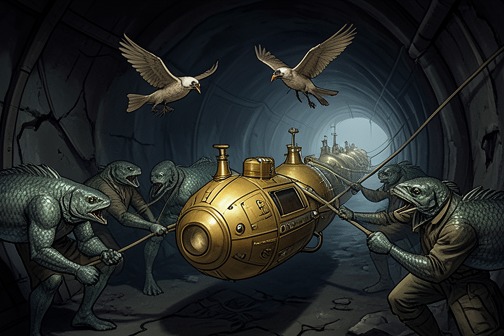
The [Empress](entity:character-recall-character-empress-e4c788f61ae7) assembled [Fish-men](entity:character-recall-character-fish-men-50f3d184cbf2) to tow the ships through the passage, [Bird-men](entity:character-recall-character-bird-men-f10444efd7ce) to serve in the air, and [Bear-men](entity:character-recall-character-bear-men-31d9cc4d5fe3) and [Worm-men](entity:character-recall-character-worm-men-adeda3331596) to travel aboard. Her subjects crowded forward to serve, and she had to provide enough vessels to carry them and their provisions.
The fleet descended beneath the water, using golden chains and the Fish-men’s strength rather than sails. The [Giants](entity:creature-recall-creature-giants-10cff8ec70ae) had arranged enough air for the land-dwelling passengers to breathe; after the ships crossed the [Icy Sea](entity:location-recall-location-icy-sea-81d48a2afedc), they surfaced near the Empress’s native kingdom, where Bear-men spotted the enemy fleet through telescopes.
on the night before the promised aid
The Fleet’s Fiery Apparition
The [Empress](entity:character-recall-character-empress-e4c788f61ae7) sent [Fish-men](entity:character-recall-character-fish-men-50f3d184cbf2) and [Bird-men](entity:character-recall-character-bird-men-f10444efd7ce) to gather intelligence about the enemy’s numbers and positions. At night, they carried thousands of wetted fire-stones above the sea and through the air, making the waters and sky appear to burn.
The enemy sailors believed the [Last Day](entity:time-recall-time-last-day-e743c00d707c) had arrived and fell to prayer. At dawn the lights were extinguished, revealing a fleet of unfamiliar ships that seemed to move without sails, guns, or visible weapons; their dark paint concealed the gold beneath and deepened the mystery.
the morning after the fiery apparition
The Empress Addresses Her Countrymen
The [Empress](entity:character-recall-character-empress-e4c788f61ae7) sent a letter to the besieged kingdom’s commanders, identifying herself as a powerful princess who had come to help against their enemies. Their council delayed its reply amid conflicting opinions, frustrating her until the [Duchess](entity:character-recall-character-duchess-9f1c6566987c) reminded her that large councils moved slowly because every counselor wished to seem wise.
When the commanders asked where she came from and how she would help, the Empress refused to disclose her origin. She promised to appear above the water in a radiant light surrounded by fire at one o’clock that night, leaving both the council and the sailors anxious for the encounter.
at one o’clock the night after her message
The Empress Appears on the Water
At the appointed hour, the [Empress](entity:character-recall-character-empress-e4c788f61ae7) appeared above the water supported on the backs of [Fish-men](entity:character-recall-character-fish-men-50f3d184cbf2), while [Bird-men](entity:character-recall-character-bird-men-f10444efd7ce) and Fish-men carried burning fire-stones around her. She approached in garments that shone with star-stone and stopped at a distance where her voice could reach the whole fleet.
She declared that she was a native of the threatened kingdom and had crossed from another world to save it. She promised to destroy its enemies at sea and assist against any enemies on land, asking only that her countrymen acknowledge her love and loyalty rather than bargain for their safety.
the following morning
The Invading Fleets Burn
The [Empress](entity:character-recall-character-empress-e4c788f61ae7) returned in imperial robes, carrying a diamond shield and a diamond spear, and directed the [Fish-men](entity:character-recall-character-fish-men-50f3d184cbf2) to attack. They carried fire-stones in diamond cases and uncovered and wetted them only when they were beneath or beside the enemy ships.
The fleets caught fire, and the flames reached their powder, blowing the vessels apart. The Empress’s countrymen hailed her as an angel sent to deliver them. She refused to return home until she had forced the rest of the world to submit to their monarch.
soon after the naval victory
The King Requests Tribute
The [Empress](entity:character-recall-character-empress-e4c788f61ae7) offered her service to the ruler of her native dominions, the [King of Esfi](entity:character-recall-character-king-of-esfi-44a2377a1572). He thanked her for defeating the sea-borne enemy but explained that hostile powers still obstructed his trade.
The Empress demanded that neighboring maritime nations pay tribute to him. When they refused, she ordered the [Fish-men](entity:character-recall-character-fish-men-50f3d184cbf2) to burn or sink their ships, using control of sea traffic to turn a military victory into a political instrument.
after the neighboring powers refuse tribute
The Maritime Nations Submit
The neighboring nations eventually sought negotiations, but the [Empress](entity:character-recall-character-empress-e4c788f61ae7) offered no terms beyond submission and tribute to the [King of Esfi](entity:character-recall-character-king-of-esfi-44a2377a1572). Faced with the destruction of their shipping and the dependence of their economies on maritime commerce, they were forced to accept.
Some powers joined together in a renewed attack, but the [Fish-men](entity:character-recall-character-fish-men-50f3d184cbf2) again destroyed their remaining naval strength. Nations able to live without foreign sea trade, and those whose commerce traveled by land, resisted the new order, prompting the Empress to turn to a different weapon.
after the maritime nations are forced to pay tribute
The Fire-Stone Campaign
The [Empress](entity:character-recall-character-empress-e4c788f61ae7) threatened the remaining resistant states with the destruction of their towns and cities. She sent [Bird-men](entity:character-recall-character-bird-men-f10444efd7ce) and [Worm-men](entity:character-recall-character-worm-men-adeda3331596) to place fire-stones under house foundations and on rooftops, warning the inhabitants that rain would set their towns ablaze.
When rain came, the stones burned more fiercely as water wetted them, and frightened neighboring powers submitted. One land that rarely received rain still resisted, but the Empress’s agents set fire-stones beneath the supports of its houses; an incoming tide ignited them, destroyed buildings, and left the country barren for the year. The remaining opposition yielded.
after the resistant nations submit
The Empress Establishes World Rule
Having defeated the invading fleets and overcome the remaining holdouts, the [Empress](entity:character-recall-character-empress-e4c788f61ae7) made her native country’s ruler the absolute monarch of the world. She had converted her intervention into a far-reaching tributary order founded on control of navigation and the threat of fire.
Princes from across the world wanted to see the ruler whose beauty and power had inspired such reports. The Empress agreed to receive them at sea, arranging a meeting that would turn her military triumph into a public declaration of the new political hierarchy.
after the conquest of the resistant nations
The Audience with the Princes
The [Empress](entity:character-recall-character-empress-e4c788f61ae7) met the assembled princes in a ring of ships, appearing in jewels and star-stone that made them believe she was a celestial or uncreated being. At night, fire-stones terrified the spectators; when the flames vanished, her luminous garments remained, and [Bird-men](entity:character-recall-character-bird-men-f10444efd7ce) lifted her into the air while [Fish-men](entity:character-recall-character-fish-men-50f3d184cbf2) answered their singing from the sea.
At daybreak she spoke for the [King of Esfi](entity:character-recall-character-king-of-esfi-44a2377a1572), declaring that he had been unjustly attacked and now possessed authority over the world. She urged the princes to pay tribute and live peacefully. After they drew back, her fleet entered the circle and sank beneath the sea, leaving the spectators astonished.
during the return voyage to the Blazing-World
The Empress Refuses to Enrich Her Family
The [Duchess](entity:character-recall-character-duchess-9f1c6566987c) wondered why the [Empress](entity:character-recall-character-empress-e4c788f61ae7), who had access to immense wealth, did not enrich her own family or the country of her birth. The Empress answered that gold and riches made people covetous and destructive; greater wealth would not satisfy their appetite, because their covetousness was infinite.
The Duchess said she would want only enough to restore what her husband had possessed before the civil wars, and even then for his descendants’ sake. She preferred the natural elixir that preserved life and health to gold or jewels, but acknowledged that material substances could not cross between worlds without a passage.
later, during a conversation between the two souls
The Duchess Defends Her Singularities
The [Empress](entity:character-recall-character-empress-e4c788f61ae7) asked why the [Duchess](entity:character-recall-character-duchess-9f1c6566987c) took such delight in being unusual in clothing, behavior, and speech. The Duchess admitted that she sought singularity and would rather be imitated than imitate, even if her difference made her seem worse than those who followed the fashion.
She dismissed the judgment of the present age and defended her virtue and chastity, insisting that acquaintances and servants could testify to her conduct. When asked why she pleaded for wicked characters in her writings, she answered that she did so to display wit, not her own nature.
upon the Empress’s return to the Blazing-World
The Emperor Welcomes the Empress
The Emperor rejoiced at the [Empress](entity:character-recall-character-empress-e4c788f61ae7)’s safe return, and she answered his love with equal affection. The [Duchess](entity:character-recall-character-duchess-9f1c6566987c)’s soul soon asked permission to return to her husband, but the Emperor first wanted her to inspect the stables and riding houses he had built in her absence.
The buildings were lavishly constructed from gold, gems, amber, crystal, and other costly materials, including a stable designed to hold two hundred horses. The display brought the Duchess’s account of the Duke’s modest circumstances into sharp contrast with the resources of the Blazing-World.
after the Duchess views the imperial stables
A Theatre for the Blazing-World
The Emperor asked the [Duchess](entity:character-recall-character-duchess-9f1c6566987c) for advice about creating a theatre. She confessed that she knew little about theatre buildings but could explain how to make plays, despite the judgment of fashionable critics who said her works could not be acted because they did not follow the rules of art.
The Emperor preferred natural descriptions of human conduct to artificial methods. The Duchess argued that fashionable plays might train whining lovers rather than wise and noble people, and said her own works might suit the Blazing-World better than the world of literary wit. The [Empress](entity:character-recall-character-empress-e4c788f61ae7) added that comic farce could accompany serious drama, using the realm’s many species as performers.
after the theatre conversation
The Duchess Returns to Her Husband
The Emperor and [Empress](entity:character-recall-character-empress-e4c788f61ae7) asked the [Duchess](entity:character-recall-character-duchess-9f1c6566987c) to stay and organize the theatre, but she longed to return to her husband. She promised to come back after a short time and left the imperial court with their permission.
Back in her own body, she told the Duke about her travels and the Empress’s praise of him. She also described the splendid horses and materials of the Blazing-World, wishing there were a passage that could bring them across; the Duke replied that good fortune had always been obstructed for him.
later, when the Duchess relates the Empress’s habits
The Empress’s Life and Pleasures
The [Duchess](entity:character-recall-character-duchess-9f1c6566987c) told acquaintances that the [Empress](entity:character-recall-character-empress-e4c788f61ae7) spent most of her time studying natural causes and effects and speaking with learned people. She traveled by land, water, or horseback, often at night, because the Blazing-World’s numerous blazing stars made its nights bright and its air temperate.
Her recreation included music by [Fish-men](entity:character-recall-character-fish-men-50f3d184cbf2) and [Bird-men](entity:character-recall-character-bird-men-f10444efd7ce), racing, flying and swimming contests, dances on land and water, and feasts of unfamiliar fruits. The Empress needed no guard against rebels or enemies, and her well-ordered world made leisure as much a feature of her reign as imperial display.
at the close of the narrative
The Authoress Claims Her World
The [Duchess](entity:character-recall-character-duchess-9f1c6566987c) presents the Blazing-World and her philosophical world as creations made from the rational parts of her own mind. She takes greater pleasure in forming them than Alexander or Caesar took in conquest, because her worlds required fewer deaths and could be shaped without disturbing a terrestrial society.
She chooses an honest figure of herself over the figures of conquerors and declares peace preferable to war, wit to policy, and honesty to beauty. Readers may imagine themselves as subjects in her creation or make worlds of their own, but she will not usurp the [Empress](entity:character-recall-character-empress-e4c788f61ae7)’s rule; her final claim is authorship over an imaginative sovereignty that remains hers to govern.